

Most people grab a bag of nuts based on whatever looks good in the moment, then wonder why their salad tastes weirdly tangy or their snack feels boring. The format and flavor of a nut matters more than most shoppers realize — and the difference between a seasoned snacking nut and a plain cooking nut isn't subtle. Use them in the wrong situation and you're either wasting a great product or undermining a dish.
The Almonds & Cashews collection at Groceryeshop covers both ends of that spectrum. Here's how to think through which one actually belongs in your cart.
The core split: seasoned vs. plain
Seasoned nuts — the kind coated with flavoring — are built for eating straight from the bag. The seasoning is the point. It's bold, it's immediate, and it's designed to satisfy a craving on its own terms. Plain nuts, by contrast, are neutral by design. Their job is to add texture, protein, and a mild nutty flavor to something else without competing with it.
That's the real dividing line, and it shapes every decision below.
When you want a snack that actually delivers
If you're reaching into a bag at 4 p.m. because you need something real between lunch and dinner, a plain nut is going to disappoint you. That's exactly the moment for Emerald Nuts Dill Pickle Seasoned Cashews. The dill pickle seasoning on these cashews is punchy and savory — the kind of flavor that makes a small handful feel genuinely satisfying rather than just functional. The resealable bag keeps them fresh between snacking sessions, which matters when you're working through a pack over several days.
These are a particularly good desk snack or road-trip nut because the flavor is interesting enough to hold your attention. Fair warning: they're not subtle. If you're someone who finds bold flavors overwhelming, these aren't your everyday nut. But if you've ever reached for chips just because you wanted something with real seasoning, this is the smarter swap.
When you want something that feels like dessert but isn't
The Emerald Cocoa Roast Almonds occupy a specific niche: the after-dinner snack moment when you want something sweet but don't want to open a full bag of candy. The cocoa flavor is roasted directly into the almond — it's not a coating that flakes off — which gives each nut a deep, chocolatey character with real crunch underneath. No artificial preservatives, flavors, or synthetic colors, and no gluten or GMOs, so the ingredient story is clean even if the flavor reads indulgent.
These also work well as a movie-night snack or mixed into a trail mix where you want a chocolate note without actual chocolate chips. What they don't work for: anything you're cooking or baking. The cocoa seasoning will clash with most savory applications, and the flavor profile is too specific to blend quietly into a recipe. Use them as-is.
When you're cooking, baking, or building a dish
This is where plain sliced almonds earn their place. Diamond of California's sliced almonds — available in both a 6 oz bag and a 2.25 oz size — are California-grown, Non-GMO Project Verified, and contain no artificial flavors. They're naturally free of cholesterol and sodium, with 6g of protein and 4g of fiber per serving. That clean, neutral profile is exactly what you want when the nut is playing a supporting role.
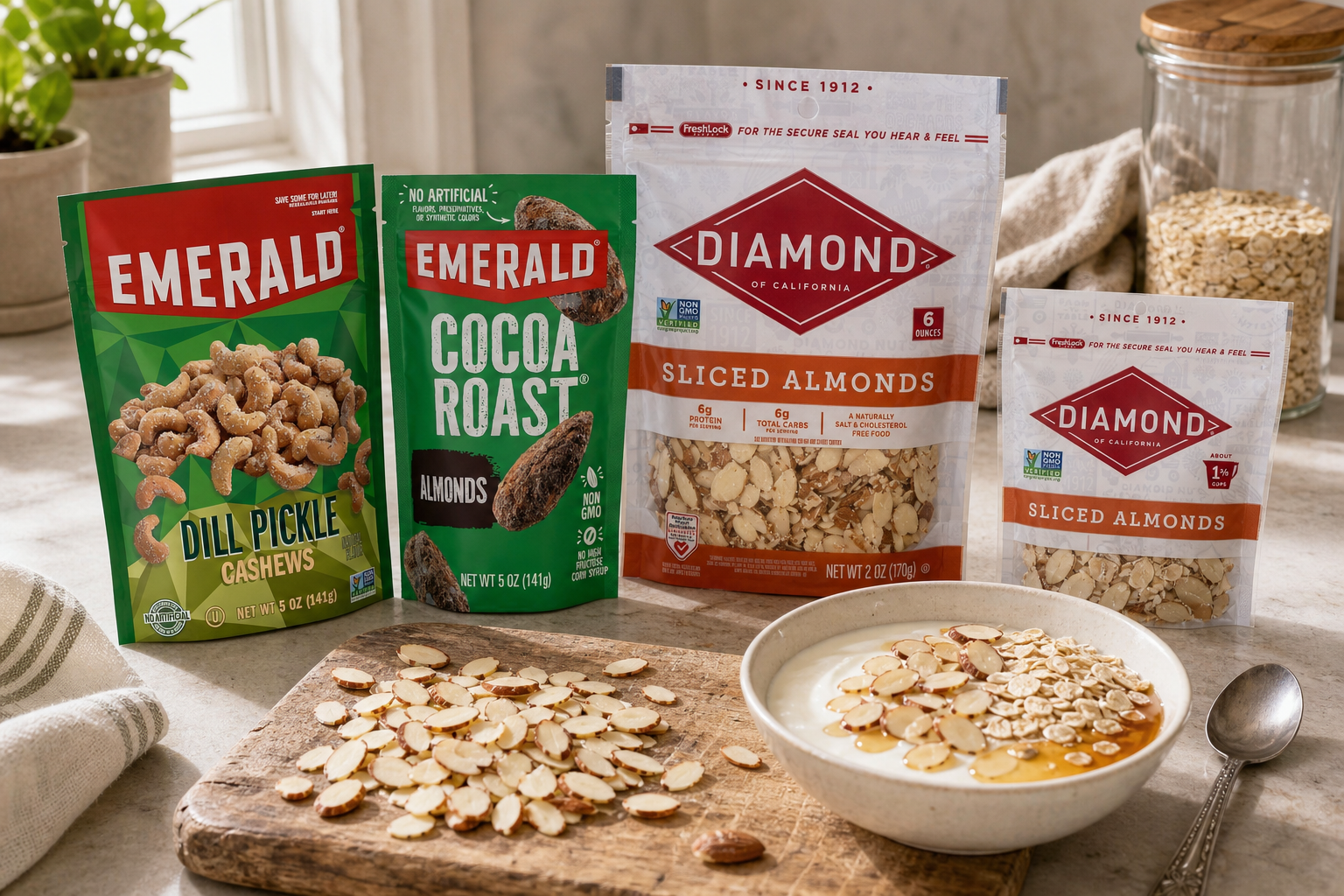
Scatter them over yogurt or oatmeal in the morning and they add crunch without changing the flavor of what you built. Toast them in a dry pan for a couple of minutes and fold them into a green salad — they go with almost any dressing because they don't bring competing seasoning. Fold them into muffin batter, sprinkle them over roasted green beans, press them onto the outside of a cheese log. The sliced format means they distribute evenly and cook quickly, which whole or chopped almonds don't always do.
The size question between the two Diamond bags is mostly a practical one. The 6 oz bag (about 1⅔ cups) suits a household that uses sliced almonds regularly — a few times a week across different meals. The 2.25 oz size is better when you need almonds for one specific recipe and don't want a half-used bag sitting in the pantry for months. Both carry the same Non-GMO Project Verified status and the same clean ingredient profile, so it's purely a volume decision.
A quick map before you order
- Bold savory snacking (straight from the bag): Emerald Dill Pickle Seasoned Cashews
- Sweet treat or dessert-adjacent snacking: Emerald Cocoa Roast Almonds
- Regular cooking, topping, and baking (frequent use): Diamond Sliced Almonds, 6 oz
- One-off recipe or smaller household: Diamond Sliced Almonds, 2.25 oz
The mistake most people make is buying a seasoned nut thinking it'll do double duty as both a snack and a cooking ingredient. It won't — or at least, it won't do the cooking job well. Keep at least one plain option and one seasoned option stocked, and you'll actually use both.
Browse the full Almonds & Cashews collection at Groceryeshop and stock the right nut for every occasion — snacking, cooking, and everything in between. And if you're thinking about how nuts fit into a broader healthy snacking strategy, our post on healthy snack alternatives is worth a read.
Frequently Asked Questions
Can I use flavored cashews or cocoa almonds in recipes?
Technically yes, but the results are usually off. Bold seasonings like dill pickle or cocoa compete with most recipe flavors rather than complementing them. Flavored nuts are engineered for standalone snacking — save them for that, and reach for plain sliced almonds when a recipe calls for nuts.
What's the difference between sliced and slivered almonds?
Sliced almonds are cut horizontally across the nut into thin, flat pieces — they toast quickly and scatter easily over salads or oatmeal. Slivered almonds are cut lengthwise into thicker matchstick-style pieces with more bite. The Diamond of California products featured here are sliced, making them the more versatile everyday option for toppings and baking.
How should I store an open bag of seasoned nuts to keep them fresh?
Both the Emerald Dill Pickle Cashews and the Emerald Cocoa Roast Almonds come in resealable bags — press out as much air as possible before sealing and store them in a cool, dry spot away from direct sunlight. Seasoned nuts can lose their crunch faster than plain ones once exposed to humidity, so the resealable closure really does make a difference.
Which size of Diamond Sliced Almonds should I buy if I cook regularly?
If you're adding sliced almonds to meals a few times a week — morning oatmeal, weeknight salads, the occasional bake — the 6 oz bag is the practical choice. It contains about 1⅔ cups and offers better value per ounce than buying multiple smaller bags. The 2.25 oz size is better suited to a single recipe or a first-time purchase when you're not sure how quickly you'll go through them.
