


You will not be allowed to compare more than 4 products at a time
View compareEnglish Tea Store Loose Leaf, Spring Pouchong Tea, 2 Ounce
English Tea Store Loose Leaf, Spring Pouchong Tea, 2 Ounce
Out of stock
Regular price
$19.70
Sale price
$19.70
Regular price
$28.14
Unit price
per
Shipping calculated at checkout.
Sold by GroceryeShop — Fresh & quality products, delivered in USA.
Returns accepted within 30 days | support@groceryeshop.us
Shipping Information
- Free Standard Shipping — United States only
- Processing Time: 3–5 business days
- Estimated Delivery: 6–10 business days after dispatch
- Securely packed to ensure your purchase arrives in perfect condition
- Tracking number sent via email once dispatched
- Orders over $250 require signature upon delivery. Taxes calculated at checkout.
Returns & Refund
Returns accepted within 30 days of delivery.
Damaged or Defective Item
Free return shipping + replacement or full refund
Wrong Item Received
Free return shipping + replacement or full refund
Change of Mind
Return shipping at customer's expense · Item must be unused & in original packaging
All returns require a Return Authorization (RA) number before sending.
View Full Return & Refund Policy
Safety & Compliance
⚠️
California Proposition 65 Warning
Some products sold on this website may expose you to chemicals known to the State of California to cause cancer, birth defects, or other reproductive harm.
www.P65Warnings.ca.gov
🛒
General Product Safety Advisory
Always read the product label, instructions, and safety warnings before use. Do not use damaged or modified products. Store products in appropriate conditions as specified by the manufacturer.
Keep all products out of reach of children unless specifically designed for their use.
ℹ️
Product Authenticity & Notice
All products sold by GroceryeShop are 100% authentic, sourced directly from trusted suppliers across the USA. Product weights and packaging may vary slightly from images due to seasonal availability and supplier updates.
GroceryeShop — Fresh, Quality Groceries Delivered Nationwide.
Couldn't load pickup availability
Guarantee safe and secure checkout

Product Description
Coming from one of the most beautiful tea producing places of the world, spring pouchong comes from pinglin township in Taiwan. Water supply to pinglin comes from one of the most pristine waterways, while the area is surrounded by thick forests, and the town is only accessible by one tiny road. This road is lined on both sides by small workshops where the pouchong is produced and packed. Tea season brings the entire town to life - as their teas have made the town famous. Pouchong comes from special bushes that grow on only a few tracts of land around the town. After plucking, the leaves are only allowed to oxidize for a limited amount of time before they are wrapped in paper and dried. Spring pouchong is processed entirely by hand in the same manner it has been for 5 generations. This delivers one of the world's most exceptional teas, with fragrances of flowers and melon, and a rich, yet mild cup. For the best brew, spring pouchong should steep in water has been brought to a light boil (165-190° f) for 1-3 minutes.
Frequently Asked Questions
- Q: What is the weight of the Spring Pouchong Tea? A: The Spring Pouchong Tea weighs zero point sixteen pounds. This lightweight packaging makes it easy to store and transport.
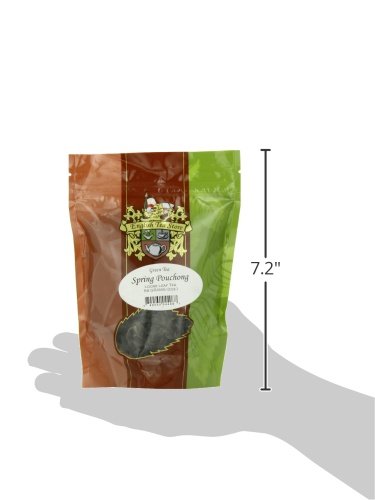
- Q: What are the dimensions of the tea package? A: The package dimensions are eight point one two eight centimeters long, zero point five zero eight centimeters wide, and seventeen point seven eight centimeters high. These compact dimensions make it convenient for storage.
- Q: How much tea is included in the package? A: The package contains two ounces of tea. This size is perfect for multiple brewing sessions.
- Q: What is the best way to brew Spring Pouchong Tea? A: To brew Spring Pouchong Tea, steep the leaves in water heated to one hundred sixty-five to one hundred ninety degrees Fahrenheit for one to three minutes. This method ensures a rich yet mild flavor.
- Q: Can I use this tea for iced tea? A: Yes, Spring Pouchong Tea can be used to make iced tea. Brew it as directed, then cool it down and serve over ice for a refreshing beverage.
- Q: Is this tea suitable for beginners? A: Yes, this tea is suitable for beginners. The brewing process is straightforward, and the flavor is mild and approachable.
- Q: How should I store the Spring Pouchong Tea? A: Store the tea in a cool, dry place away from light and moisture. Proper storage will help maintain its freshness and flavor.
- Q: How long can I keep this tea before it goes bad? A: When stored properly, Spring Pouchong Tea can last up to twelve months. Always check for freshness before brewing.
- Q: Is this tea organic? A: The product details do not specify if the tea is organic. For organic certification, please check the packaging or contact the manufacturer.
- Q: Does this tea contain any allergens? A: No, the Spring Pouchong Tea does not list any allergens. However, always check the packaging for any potential cross-contamination warnings.
- Q: What is the flavor profile of Spring Pouchong Tea? A: Spring Pouchong Tea has fragrances of flowers and melon, resulting in a rich yet mild cup. This unique flavor profile makes it distinct among teas.
- Q: How is Spring Pouchong Tea processed? A: Spring Pouchong Tea is processed entirely by hand. The leaves are oxidized for a limited time before drying, maintaining quality over generations.
- Q: Can I use this tea for cooking? A: Yes, you can use Spring Pouchong Tea for culinary purposes. It can enhance flavors in various dishes, especially in marinades and desserts.
- Q: What tea category does Spring Pouchong belong to? A: Spring Pouchong Tea is categorized as a black tea. This classification highlights its unique processing and flavor characteristics.
- Q: Does this tea come with a guarantee? A: The product details do not mention a guarantee. For warranty information, please check with the manufacturer.
- Q: What is the country of origin for this tea? A: The Spring Pouchong Tea originates from Taiwan. The unique climate and soil contribute to its exceptional flavor.