


You will not be allowed to compare more than 4 products at a time
View compareHakubaku Organic Soba, Authentic Japanese Buckwheat Noodles (No Salt Added)
Hakubaku Organic Soba, Authentic Japanese Buckwheat Noodles (No Salt Added)
Out of stock
Regular price
$22.36
Sale price
$22.36
Regular price
$22.36
Unit price
per
Shipping calculated at checkout.
Sold by GroceryeShop — Fresh & quality products, delivered in USA.
Returns accepted within 30 days | support@groceryeshop.us
Shipping Information
- Free Standard Shipping — United States only
- Processing Time: 3–5 business days
- Estimated Delivery: 6–10 business days after dispatch
- Securely packed to ensure your purchase arrives in perfect condition
- Tracking number sent via email once dispatched
- Orders over $250 require signature upon delivery. Taxes calculated at checkout.
Returns & Refund
Returns accepted within 30 days of delivery.
Damaged or Defective Item
Free return shipping + replacement or full refund
Wrong Item Received
Free return shipping + replacement or full refund
Change of Mind
Return shipping at customer's expense · Item must be unused & in original packaging
All returns require a Return Authorization (RA) number before sending.
View Full Return & Refund Policy
Safety & Compliance
⚠️
California Proposition 65 Warning
Some products sold on this website may expose you to chemicals known to the State of California to cause cancer, birth defects, or other reproductive harm.
www.P65Warnings.ca.gov
🛒
General Product Safety Advisory
Always read the product label, instructions, and safety warnings before use. Do not use damaged or modified products. Store products in appropriate conditions as specified by the manufacturer.
Keep all products out of reach of children unless specifically designed for their use.
ℹ️
Product Authenticity & Notice
All products sold by GroceryeShop are 100% authentic, sourced directly from trusted suppliers across the USA. Product weights and packaging may vary slightly from images due to seasonal availability and supplier updates.
GroceryeShop — Fresh, Quality Groceries Delivered Nationwide.
Couldn't load pickup availability
Guarantee safe and secure checkout

Product Description
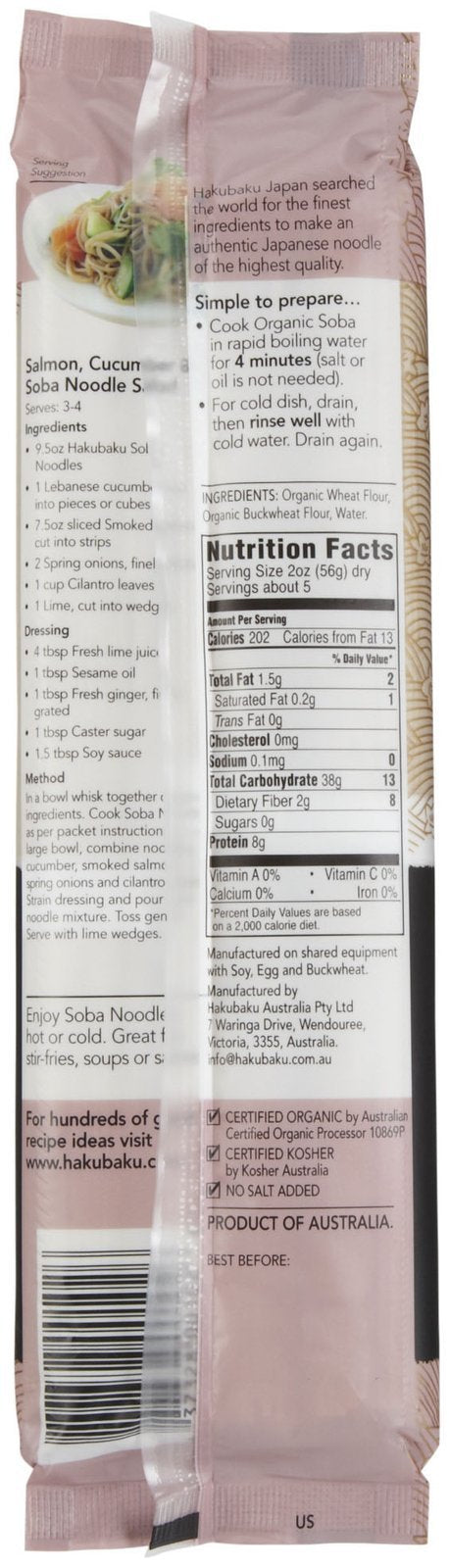
Soba Noodles Are Thin Japanese Noodles Made Of Buckwheat Flour (Soba-Ko) And Wheat Flour (Komugi-Ko). They Are Roughly As Thick As Italian Spaghetti, And Prepared In Various Hot And Cold Dishes. The Most Basic Soba Dish Is Zaru Soba In Which Boiled, Cold Soba Noodles Are Eaten With A Soya Based Dipping Sauce (Tsuyu). Buckwheat Is Very High In Protein Which Has All Of The Amino Acids Essential For Good Health. Buckwheat Protein Has Also Been Shown To Reduce Cholesterol Levels By Absorbing Cholesterol In Your Small Intestine. Buckwheat May Have Some Value For Diabetics As Some Studies On Rats Have Shown That Buckwheat Reduces Blood Glucose Levels By As Much As 12-19%. Buckwheat Is A Naturally High In Dietary Fiber, Lecithin.Features Include: &Bull;Case Of Eight, 9.5- Ounce Boxes (Total Of 76 Ounces)&Bull;Usda Organic&Bull;Made With Certified Ingredients&Nbsp;
Frequently Asked Questions
- Q: What are the main ingredients in Hakubaku Organic Soba? A: Hakubaku Organic Soba is made from buckwheat flour and wheat flour. These ingredients create a traditional Japanese noodle that is versatile for various dishes.
- Q: How much does each box of Hakubaku Organic Soba weigh? A: Each box contains nine and a half ounces of soba noodles. The total weight for a case of eight boxes is seventy-six ounces.
- Q: Is Hakubaku Organic Soba USDA certified organic? A: Yes, Hakubaku Organic Soba is USDA certified organic. This means that it meets strict standards for organic farming and ingredient sourcing.
- Q: How do I prepare Hakubaku Organic Soba noodles? A: To prepare Hakubaku Organic Soba, boil the noodles for about five to seven minutes until tender. Then, rinse them under cold water for cold dishes or serve them hot with broth.
- Q: Can I eat Hakubaku Organic Soba noodles cold? A: Yes, you can eat Hakubaku Organic Soba cold. A popular dish is zaru soba, where the cold noodles are served with a soy-based dipping sauce.
- Q: Is Hakubaku Organic Soba suitable for a gluten-free diet? A: No, Hakubaku Organic Soba contains wheat flour, which is not gluten-free. Those with gluten sensitivities should look for alternative gluten-free noodles.
- Q: How should I store unopened boxes of Hakubaku Organic Soba? A: Store unopened boxes of Hakubaku Organic Soba in a cool, dry place. This helps maintain the quality and freshness until you are ready to use them.
- Q: What is the shelf life of Hakubaku Organic Soba? A: The shelf life of Hakubaku Organic Soba is typically around two years when stored properly. Always check the expiration date on the box before use.
- Q: Can I freeze Hakubaku Organic Soba noodles? A: No, it is not recommended to freeze Hakubaku Organic Soba noodles. Freezing can alter their texture and quality.
- Q: Are there any allergens in Hakubaku Organic Soba? A: Yes, Hakubaku Organic Soba contains wheat, which is a common allergen. Always check for specific allergen information on the packaging.
- Q: How does buckwheat in Hakubaku Soba benefit health? A: Buckwheat is high in protein and dietary fiber, which can help lower cholesterol levels and potentially reduce blood glucose levels.
- Q: What dishes can I make with Hakubaku Organic Soba? A: You can make a variety of dishes with Hakubaku Organic Soba, including soba salad, soba soup, and stir-fried soba noodles.
- Q: Is Hakubaku Organic Soba suitable for vegetarians? A: Yes, Hakubaku Organic Soba is suitable for vegetarians. It contains no meat or animal-derived ingredients.
- Q: How do I know if Hakubaku Organic Soba noodles are cooked properly? A: Hakubaku Organic Soba is cooked properly when they are tender yet firm to the bite, usually taking about five to seven minutes to boil.
- Q: What is the serving size for Hakubaku Organic Soba? A: A typical serving size for Hakubaku Organic Soba is two ounces of dry noodles. This amount will yield approximately one cup of cooked noodles.