


You will not be allowed to compare more than 4 products at a time
View compareNatural Probiotic Selection Yogurt Starter Cultures - Pack of 3 Freeze-Dried Sachets for Lactobacillus Rhamnosus and L.Gasseri Y
Natural Probiotic Selection Yogurt Starter Cultures - Pack of 3 Freeze-Dried Sachets for Lactobacillus Rhamnosus and L.Gasseri Y
Out of stock
Regular price
$12.76
Sale price
$12.76
Regular price
$12.76
Unit price
per
Shipping calculated at checkout.
Sold by GroceryeShop — Fresh & quality products, delivered in USA.
Returns accepted within 30 days | support@groceryeshop.us
Shipping Information
- Free Standard Shipping — United States only
- Processing Time: 3–5 business days
- Estimated Delivery: 6–10 business days after dispatch
- Securely packed to ensure your purchase arrives in perfect condition
- Tracking number sent via email once dispatched
- Orders over $250 require signature upon delivery. Taxes calculated at checkout.
Returns & Refund
Returns accepted within 30 days of delivery.
Damaged or Defective Item
Free return shipping + replacement or full refund
Wrong Item Received
Free return shipping + replacement or full refund
Change of Mind
Return shipping at customer's expense · Item must be unused & in original packaging
All returns require a Return Authorization (RA) number before sending.
View Full Return & Refund Policy
Safety & Compliance
⚠️
California Proposition 65 Warning
Some products sold on this website may expose you to chemicals known to the State of California to cause cancer, birth defects, or other reproductive harm.
www.P65Warnings.ca.gov
🛒
General Product Safety Advisory
Always read the product label, instructions, and safety warnings before use. Do not use damaged or modified products. Store products in appropriate conditions as specified by the manufacturer.
Keep all products out of reach of children unless specifically designed for their use.
ℹ️
Product Authenticity & Notice
All products sold by GroceryeShop are 100% authentic, sourced directly from trusted suppliers across the USA. Product weights and packaging may vary slightly from images due to seasonal availability and supplier updates.
GroceryeShop — Fresh, Quality Groceries Delivered Nationwide.
Couldn't load pickup availability
Guarantee safe and secure checkout


Product Description
History Balkans long and affectionate relationship with yogurt dates back to the Thracians, ancient inhabitants of the Balkan Peninsula before more than 3000 years when stock-breeders placed sheeps milk in lambskin bags around their waists and fermented yogurt using their own body heat. The word yogurt is derived from the words for thick and milk in ancient Thracian. In the early 1900s, a Bulgarian scientist called Dr. Stamen Grigorov, found an agent causing Bulgarian yogurt fermentation - a specific bacillus. Grigorov went on to pinpoint two more bacteria: a Streptobacillus and a harmful Streptoccus thermophilus which coexisted with that Lactobacillus in what appeared to be a perfect symbiosis. He also discovered that these two bacteria are not part of the micro-flora that exists in the human intestinal tract; however, they turn out to be very beneficial to it when introduced in it. Interested in Dr. Grigorovs discoveries, another scientist, the Russian Ilya Mechnikov, a Nobel Prize laureate in Physiology and Medicine, went on to discover that more people lived to the age of 100 in Bulgaria than in any of the 36 other countries he studied. He directly linked this to the countrys most traditional food - yogurt. According to Metchnikoffs research, the ageing process results from the activity of putrefactive (proteolytic) microbes producing toxic substances in the large bowel. Based on these facts, Metchnikoff proposed that consumption of fermented milk would seed the intestine with harmless lactic-acid bacteria and decrease the intestinal pH and that this would suppress the growth of proteolytic bacteria, that he called Bulgarian Bacillus.
Frequently Asked Questions
- Q: What ingredients are in the Natural Probiotic Selection Yogurt Starter Cultures? A: The starter cultures contain live active bacteria including Lactobacillus rhamnosus, Lactobacillus gasseri, Lactobacillus bulgaricus, and Streptococcus thermophilus. These bacteria are essential for yogurt fermentation and beneficial for gut health.
- Q: How many sachets are included in the pack? A: There are three sachets included in the pack. Each sachet can be used to make between one to three liters of yogurt.
- Q: What is the shelf life of these yogurt starter cultures? A: The shelf life is typically around twelve months when stored in a cool, dry place. Always check the packaging for specific expiration dates.
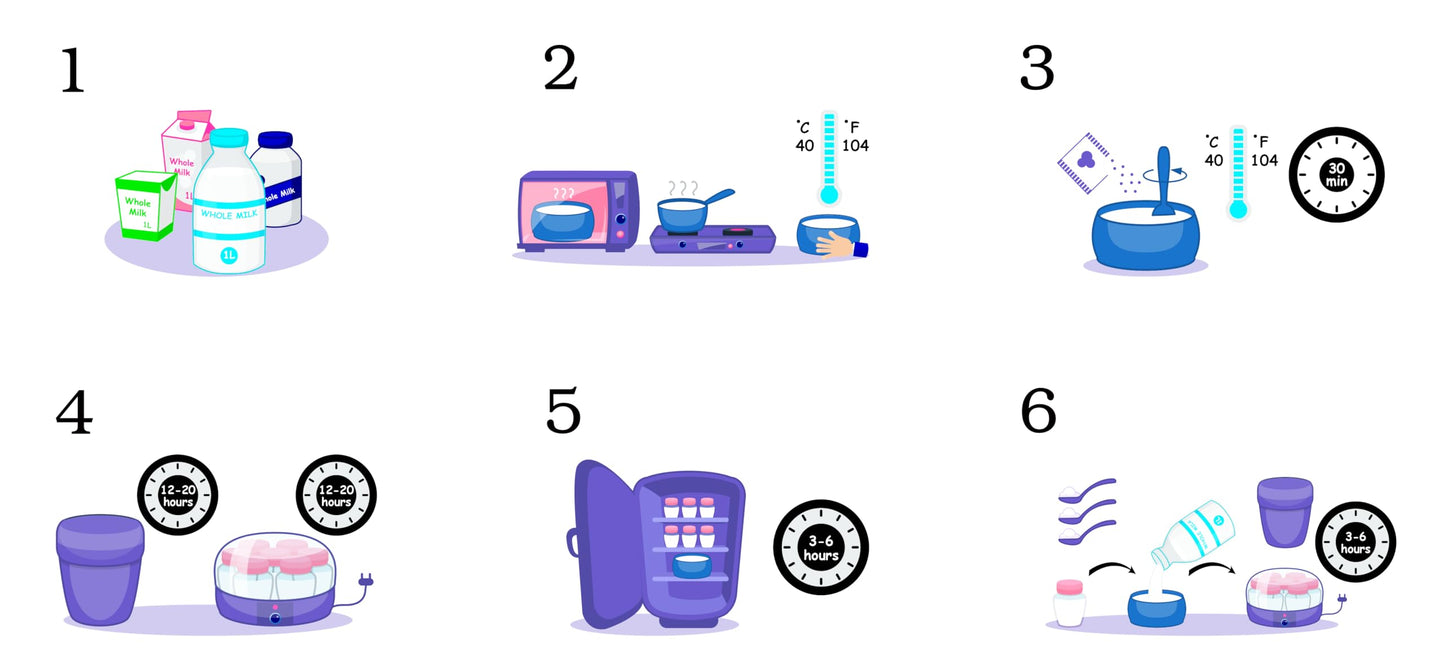
- Q: How do I use the yogurt starter cultures? A: To use the cultures, simply mix one sachet with milk in your yogurt-making appliance. Follow the specific instructions of your appliance for optimal results.
- Q: Can I reuse the starter cultures to make more yogurt? A: Yes, you can reculture yogurt multiple times using the same starter. This allows you to continue making yogurt as long as you maintain proper conditions.
- Q: Is this yogurt starter suitable for beginners? A: Yes, this starter is suitable for beginners. The straightforward instructions make it easy for anyone to start making homemade yogurt.
- Q: How should I store the yogurt starter sachets? A: Store the sachets in a cool, dry place away from direct sunlight. Keeping them sealed until use will help maintain the active cultures.
- Q: Are these cultures gluten-free? A: Yes, the Natural Probiotic Selection Yogurt Starter Cultures are gluten-free. They are made without additives or maltodextrin.
- Q: Can I use alternative milks with these cultures? A: Yes, you can use alternative milks such as almond or coconut milk, but results may vary based on the type of milk used.
- Q: What is the best temperature for fermenting yogurt? A: The ideal fermentation temperature is between one hundred to one hundred twelve degrees Fahrenheit. This temperature range helps the bacteria thrive.
- Q: What if my yogurt doesn't set properly? A: If your yogurt doesn't set, ensure the fermentation temperature was maintained. Also, check the expiration of your starter cultures.
- Q: Are these cultures safe for children? A: Yes, the cultures are safe for children. They contain beneficial bacteria that can help support digestive health.
- Q: How do I clean my yogurt-making appliance? A: To clean your yogurt maker, unplug it and wash the container with warm, soapy water. Rinse thoroughly to remove any soap residue.
- Q: Can I add flavors to my yogurt? A: Yes, you can add flavors such as vanilla, fruit, or honey after the yogurt has set. This allows for customized taste.
- Q: What should I do if the sachet is damaged? A: If a sachet is damaged, do not use it. Contact the manufacturer for a replacement or refund if necessary.