

You've seen the labels: uplifting, revitalizing, calming. They sound great on a shelf, but standing in front of three amber bottles trying to figure out which one you actually need? That's where most people just grab the one with the prettiest font and hope for the best.
If you're new to essential oils — or you've owned a few and never quite figured out when to reach for each one — this guide is for you. We're going to take three specific Aura Cacia oils and map them to real moments in your day, so you stop guessing and start using them in a way that actually makes a difference.
First: What Do Those Mood Labels Actually Mean?
Aura Cacia labels their oils with single-word mood descriptors, and while those words are honest, they're also shorthand. "Uplifting" doesn't mean the same thing as "energizing." "Revitalizing" isn't the same as "stimulating." And "pillow potion" is the most literal of the bunch — it tells you exactly when to use it, just not why it works.
The more useful question isn't what mood does this create? It's what's going on with me right now, and what do I actually need? That's the frame we'll use for each oil below.
1. Aura Cacia Bergamot Essential Oil — For When You Need a Lighter Headspace
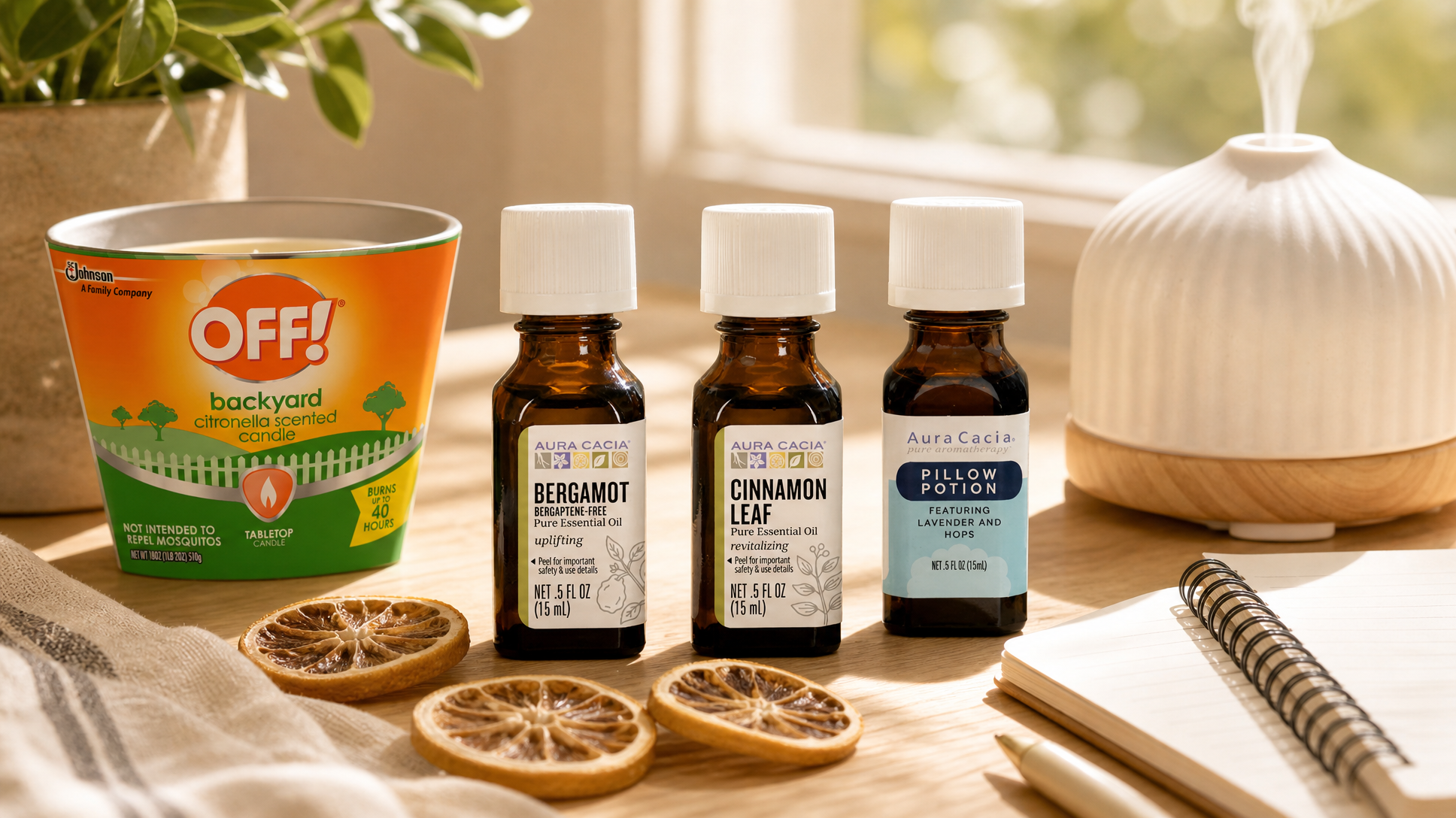
The Aura Cacia 100% Pure Bergaptene-Free Bergamot Essential Oil is labeled "uplifting," and that's a genuinely accurate descriptor — but it's most useful when you understand what kind of uplift it offers. Bergamot is a citrus oil (from Citrus bergamia), and its scent is lighter and more floral than, say, orange or lemon. It's less of a "wake up and attack the day" smell and more of a "clear the mental clutter" one.
The best time to reach for this one: mid-morning when you're not quite in a bad mood but you're not quite in a good one either. The kind of Tuesday where you're staring at your screen and nothing feels urgent or interesting. A few drops in a diffuser while you work can shift the atmosphere of a room without being distracting.
It's also worth noting this is a bergaptene-free version — bergaptene is a compound in bergamot that can cause photosensitivity on skin. If you ever want to use it topically (diluted in a carrier oil, always), this formulation removes that concern.
Reach for Bergamot when: You feel emotionally flat, mildly anxious, or stuck in a low-grade funk and want to lighten the mood without a jolt.
2. Aura Cacia Cinnamon Leaf Essential Oil — For When You Need to Actually Wake Up
If Bergamot is a gentle nudge, the Aura Cacia Cinnamon Leaf Essential Oil is a firm tap on the shoulder. Labeled "revitalizing," cinnamon leaf has a warm, spicy, distinctly bold scent — nothing subtle about it. This is the oil for moments when "uplifting" isn't going to cut it.
Think: the 2 p.m. slump after lunch when your eyes are getting heavy. Or a slow Monday morning when you need to get something done but your brain hasn't fully arrived yet. Cinnamon leaf in a diffuser creates a noticeably different energy in a room — it's warming and grounding in a way that feels active rather than relaxing.
One important note: cinnamon leaf oil is potent and can be a skin irritant if used undiluted or in high concentrations topically. For diffusing purposes it's fine in normal amounts, but always check the label's safety guidance before using it any other way.
Reach for Cinnamon Leaf when: You need real, tangible re-engagement — a workout warm-up, a focus session, or any moment where you need your body and brain to feel switched on.
3. Aura Cacia Essential Oil Pillow Potion — For When You Need to Actually Wind Down
The Aura Cacia, Essential Oil Pillow Potion is the most self-explanatory of the three — it features lavender and hops, and it's built specifically for the end of the day. Lavender is one of the most widely studied aromatherapy ingredients for relaxation, and hops (yes, the same plant used in brewing) has a long history of use as a calming herb.
The name "pillow potion" is doing exactly what it says: this is your pre-sleep ritual in a bottle. A few drops on your pillow, in a bedside diffuser, or diluted and applied to your wrists before you lie down creates a sensory cue that tells your nervous system the day is done. If you've ever struggled to mentally clock out after a busy evening — kids in bed, dishes done, but your brain still running through tomorrow's to-do list — a consistent scent ritual can genuinely help.
It also works well during quiet wind-down moments that aren't strictly bedtime: a bath, a slow Sunday afternoon, or any stretch of the day where you're deliberately trying to decompress rather than perform.
Reach for Pillow Potion when: You want to signal to your body that it's time to slow down — whether that's at 10 p.m. or during a rare quiet hour in the afternoon.
How to Actually Use Them (Without Overcomplicating It)
You don't need an elaborate setup. A basic ultrasonic diffuser, a few drops in a bowl of warm water, or even a drop on a cotton ball near your workspace all work. For topical use, always dilute essential oils in a carrier oil like coconut or jojoba — never apply undiluted oil directly to skin.
The simplest system: keep Bergamot at your desk, Cinnamon Leaf in the kitchen or gym bag, and Pillow Potion on your nightstand. Each one has a home, and you'll reach for the right one without thinking about it.
A Quick Side-by-Side
- Bergamot (Uplifting): Citrusy, floral, lighter mood shift — best for mid-morning or emotional flatness
- Cinnamon Leaf (Revitalizing): Warm, spicy, bold — best for afternoon slumps or focus sessions
- Pillow Potion (Lavender + Hops): Soft, herbaceous, calming — best for wind-down and pre-sleep rituals
And the Off! Backyard Citronella Scented Candle? That one belongs on your patio table — it's a citronella-scented tabletop candle with up to 40 hours of burn time, designed for outdoor ambiance. It's not an aromatherapy product (the packaging is clear that it's not intended to repel mosquitoes), but if you're building out a relaxed backyard evening, it pairs naturally with the kind of intentional atmosphere these oils help create indoors.
Not sure which Aura Cacia oil fits where you are right now? Browse our best sellers at Groceryeshop and find the one that matches your moment — all three are available and ready to ship.
Frequently Asked Questions
What's the difference between bergamot essential oil and other citrus oils?
Bergamot comes from the Citrus bergamia fruit and has a distinctly floral, slightly herbal quality that sets it apart from sharper citrus oils like lemon or orange. It's lighter and more complex in scent, which is why it's often described as "uplifting" rather than simply energizing. The Aura Cacia version is also bergaptene-free, which removes the photosensitivity concern associated with standard bergamot oil.
Can I use all three oils in the same diffuser session?
Technically yes, but it's not usually recommended — blending oils without knowing how they interact can muddy the scent and dilute the effect of each one. These three oils are designed for different parts of the day, so you'll get more out of them by using each one in its intended moment rather than combining them.
Is the Pillow Potion safe to use directly on skin?
Always check the product label for specific use directions. As a general rule with essential oils, diluting in a carrier oil before any skin application is the safer approach. The Aura Cacia Pillow Potion is designed primarily for aromatic use — diffusing or applying to fabric like a pillow — so start there and follow the label's safety guidance for anything beyond that.
How long does a 15 ml bottle of essential oil last?
It depends entirely on how often you use it and how many drops you add per session. Essential oils are used in small quantities — typically just a few drops at a time — so a 15 ml bottle tends to last most people through many sessions. If you're diffusing a couple of times a week, a single bottle can go a long way. Heavier daily use will shorten that considerably.
